“The unexamined life is not worth living.” — Socrates
Athens was more than another destination on our journey. In many ways, it was where this journey began.
Forty years ago, Bill Taylor built the original Arete West program around the ideals born in this city, later capturing that experience in his book, Athenian Odyssey. Before arriving, we all read his text, and thanks to his son, Jess Taylor, we explored Athens using his Athenian Odyssey guide, following the same paths that inspired generations before us.
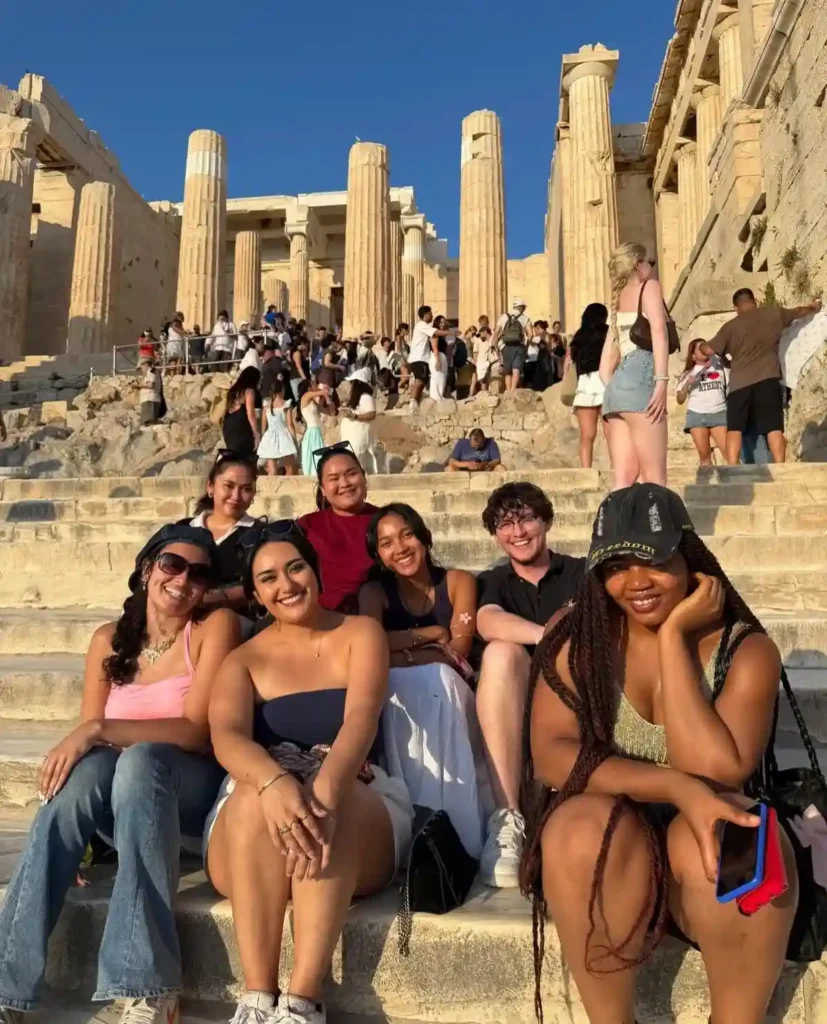
We climbed the marble slopes of the Acropolis, watching the sun sink behind the Parthenon, whose columns still stand as a reminder of the remarkable civilization that once flourished here. We walked where Pericles envisioned democracy, where Euripides challenged audiences to examine themselves, and where Aristotle transformed curiosity into systematic inquiry.
The next morning, we entered the ancient Agora, where Socrates spent his days asking questions that still echo across twenty-four centuries. Nearby, we stood before the prison where he accepted death rather than abandon his principles.
As we arrived, the sky suddenly darkened. Clouds edged with an almost luminous green rolled overhead, thunder cracked across the city, and rain began to fall. It felt as though history itself had come alive.
Standing there, one message became unmistakably clear.
To the young: Never stop asking “Why?” Live a life of self-examination, and never surrender your conscience to the crowd.
To those of us entrusted with guiding the next generation: Spare nothing in helping young people discover their own arete—their highest human potential—even when doing so demands sacrifice.
But perhaps the greatest question Athens left us with was not about Socrates alone.
How did one city, at one moment in history, produce Socrates, Plato, Aristotle, Pericles, Sophocles, Euripides, Phidias, and so many others whose ideas continue to shape civilization?
History suggests that extraordinary people do not emerge by accident. They arise when a culture values dialogue over dogma, questions over certainty, virtue over comfort, and education as the highest calling.
That is the question we carried home from Athens, and, in many ways, the question that inspired the Arete Academy itself.
How do we create an environment where the next generation of extraordinary human beings can emerge?