
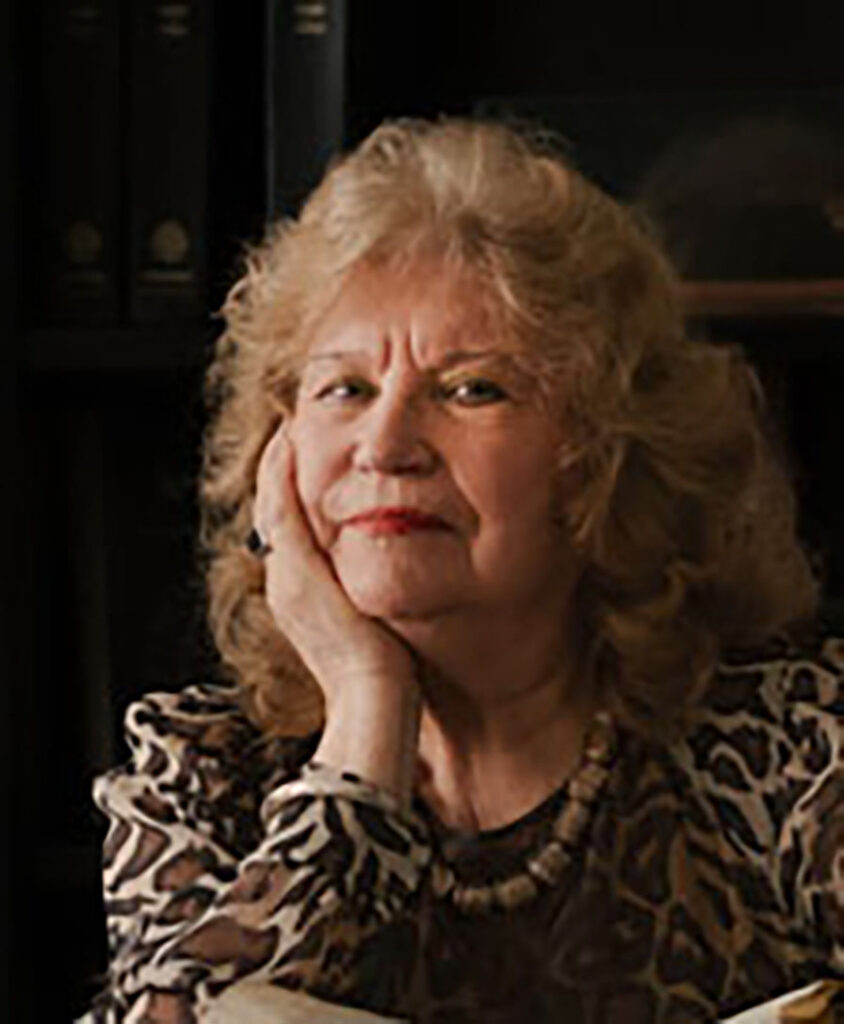
“Dialogue helps people to be born again, to discover new senses of their own existence and that of others.”
“I believe that even the most brilliant technological achievements cannot replace the strength and moral purity of the human spirit.”
“Culture is not only a treasury of values from the past, but a moral obligation for the present and the future.”
Dr. Axinia Djurova is a distinguished Bulgarian art historian, philologist, and cultural scholar whose work spans Slavo-Byzantine studies, manuscript preservation, and intercultural dialogue. A professor emeritus at Sofia University “St. Kliment Ohridski” and corresponding member of the Bulgarian Academy of Sciences, she has also served as Vice-Rector of the university and is a Doctor Honoris Causa of Soka University.
Her academic training includes degrees in Bulgarian philology and art history from Sofia and Moscow, with further specialization at the University of Belgrade. She has taught and conducted research at institutions around the world, including Yale University, the Vatican Library, the Hebrew University of Jerusalem, and the Sorbonne. Notably, she created the first inventory of Slavonic manuscripts at the Vatican Library and has authored numerous books and documentary films on Byzantine art and cultural heritage.
In recognition of her lifetime achievements, Dr. Djurova has been awarded the Honorary Badge (Neck Order) of Sofia University for her outstanding contribution to scholarship and the founding of the Center for Slavo-Byzantine Studies “Prof. Ivan Dujchev.” She is also the recipient of the Golden Bulgarian Rose Award for her cultural and charitable contributions, and has served as Chair of the Jury for the Zahari Zograf National Painting Prize, one of Bulgaria’s most prestigious art honors.
Deeply committed to ethical dialogue and global understanding, Dr. Djurova co-authored two book-length dialogues with peace philosopher Daisaku Ikeda: The Beauty of a Lion’s Heart (1999) and Awakening a Great Revival of Our Humanity (2017). Her intellectual pursuits reflect a lifelong dedication to preserving the moral and spiritual legacy of culture while promoting the transformative power of human connection. Her contributions to education, literature, and international cooperation exemplify the spirit of Arete—cultivating dignity, wisdom, and global citizenship.
Source: Sofia University Press (original Bulgarian edition: Princeps, Sofia, 2000)
Topic: First published dialogue with Daisaku Ikeda, focusing on the spiritual dimensions of courage and intercultural understanding through the lens of literature and humanism.
Awakening a Great Revival of Our Humanity (url unavailable)
Source: University Publishing House “St. Kliment Ohridski,” Sofia University Press. 2017 dialogue; Bulgarian edition October 2020.
Topic: A second dialogue with Daisaku Ikeda emphasizing the urgent need for ethical renewal, cultural memory, and education to cultivate a global humanistic spirit.
In the World of the Manuscripts (2007)
Source: Sofia University Press, 2007 (St. Kliment Ohridski)
Topic: A landmark study of Slavo-Byzantine manuscripts, presenting rich insight into their artistic, theological, and historical significance. Features over 470 pages with visual illustrations.
The Dialogue: Audiatur et altera pars — May the Other Side Also be Heard (February 2025)
Source: The Journal of Oriental Studies, Vol. 34
Topic: In this featured essay, Djurova explores the transformative role of intercultural dialogue, urging for deeper listening as a foundation of humanistic engagement and peacebuilding.
Sacred Art, Secular Context: Objects of Art from the Byzantine Collection at Dumbarton Oaks (1994)
Source: Edited volume featuring Dr. Djurova among contributing scholars
Topic: A multidisciplinary examination of Orthodox manuscript and icon traditions, with Djurova’s contributions shedding light on the sacred aesthetic of Byzantine visual culture.
Support the Arete Youth Academy through your donor-advised fund or by including us in your will or estate plan.
To recommend a grant through your DAF (e.g., Fidelity, Schwab, Vanguard), direct it to:
Agora Productions, Inc.
EIN: 20-8516833
Please note “Arete Youth Academy” in the designation.
To make a planned gift, you can help ensure that future generations benefit from an education grounded in peace, dialogue, and global citizenship.
We’re happy to work with you and your advisor to make the process simple and meaningful.
Contact: AreteGiving@AgoraProductions.org
Many employers match donations made to Agora Productions, Inc.—the nonprofit home of Arete Youth Academy. It’s a simple way to amplify your impact and support transformative education for emerging global leaders. Just enter your company name in the popup window to the right and follow the steps to submit your match request.
If your company or institution is interested in supporting AYA in other ways, such as partnerships, grants, visibility opportunities, co-branded materials, or speaking engagements with our founders or advisors, we’d love to hear from you. Please contact us at AreteGiving@AgoraProductions.org to explore meaningful collaboration.
Stock Donation Instructions
Thank you for your interest in supporting The Arete Youth Academy (an Agora Productions program) with a stock donation. Below are the instructions your broker will need to initiate a direct transfer of securities to our Charles Schwab brokerage account:
Brokerage Transfer Details (DTC Delivery):
Important Notes:
Contact for Confirmation or Questions:
Darin Nellis
Executive Director, The Arete Youth Academy/Agora Productions
(310) 694-8119
We are deeply grateful for your generous support. Your contribution will help us empower the next generation of global leaders.
Warm regards,
The Arete Youth Academy Team
Click here to visit our Arete Youth Academy Fundraising Page on Facebook.
Hit “Share” to share it with your friends on Facebook to multiply your donation and help us reach more supporters.
Bill Taylor was the visionary founder of the original Arete West program, which ran from 1979 to 2017. Over the course of 40 years, he personally led students on 20 transformative journeys across the globe, inspiring hundreds of young people to pursue wisdom, leadership, and compassionate service. His encouragement helped spark the creation of the Arete Youth Academy, which carries forward his mission to empower youth through education. This scholarship fund ensures his legacy continues to shape future generations.
To designate your gift:
1. Visit our donation page.
2. Enter your donation amount and choose the “Give in honor or in memory of someone” option.
3. In the “Honoree’s Name” field, type “Bill Taylor Scholarship Fund”
Gifts to the Bill Taylor Scholarship Fund will be used to provide tuition support for one or more participants in each cohort—extending Bill’s spirit of mentorship and service to future generations.
We’ll send a personalized message to your honoree or their family, letting them know how their influence continues to empower youth through Arete.
In France, Creative Scholars will explore the humanistic tradition through Victor Hugo’s Les Misérables, examining questions of justice, conscience, inequality, redemption, and the individual’s responsibility to society. Near Paris, students will return to the Literary House of Victor Hugo at the Château des Roches in Bièvres, which Daisaku Ikeda founded as an international center for literature, art, and cultural exchange. Through Hugo’s life and work, participants will consider how literature can challenge injustice and awaken compassion. Visits to Parisian cultural and historical sites, together with dialogue with French scholars and young people, will connect the ideals of nineteenth-century humanism to the challenges facing a new generation of global citizens.
In China, students will explore one of the world’s oldest continuous civilizations while examining the relationship between Confucian humanism, collective responsibility, modernization, and global citizenship. In Beijing, Tu Weiming and Daisaku Ikeda’s New Horizons in Eastern Humanism will frame the dialogue on Chinese philosophy and the encounter between Eastern and Western thought, complemented by films such as Zhang Yimou’s To Live. Participants will engage in dialogue with students and scholars at Peking University and explore Beijing’s historical and contemporary life. A possible journey to Xi’an, the ancient capital and eastern gateway of the Silk Road, will illuminate centuries of exchange among Chinese, Buddhist, Islamic, and Central Asian civilizations.
In Italy, Creative Scholars will explore the evolution of Western humanism from the classical world through the Renaissance. In Florence, Dante’s Divine Comedy will provide a lens for examining moral choice, transformation, and the human journey, while Michelangelo’s David and Renaissance art will illuminate changing ideas of human dignity and potential. Students will also explore the life and legacy of Florence Nightingale, who was born in Florence in 1820, examining how compassion, disciplined learning, evidence, and service enabled her to transform nursing, professional education, and healthcare worldwide. In Rome, the legacy of the ancient world and the emergence of Christianity will be explored alongside Reza Aslan’s Jesus of Nazareth. In Naples, participants may collaborate with Scholas Occurrentes, engaging young people in dialogue around culture, community, human dignity, and the challenges facing their generation.
In Greece, students will walk in the footsteps of the world’s first philosophers—tracing the origins of inquiry, democracy, and the examined life. Standing in the Agora, where Socrates engaged young Athenians in fearless dialogue about virtue and truth, participants will reflect on how authentic conversation remains the heartbeat of human progress. Visits to the Parthenon, the Acropolis Museum, and the ruins of Aristotle’s Lyceum will anchor discussions on the birth of reason and the moral responsibilities of free thought. Key readings will include selections from Plato’s Apology and Republic, Pericles’ Funeral Oration, and Constantine Cavafy’s timeless poem Ithaka, urging travelers to cherish the inner journey as much as the destination. Students will also explore Aristotle’s Nicomachean Ethics, reflecting on his vision of “eudaimonia”—a flourishing life achieved through virtue and self-mastery—and its relevance to modern global citizenship.
In Japan, Creative Scholars will explore courage, conscience, loyalty, and the complex relationship between individual character and responsibility to society. In Tokyo, students will examine Bushidō, the Meiji transformation, and Japan’s encounter with Western modernity, asking how a civilization can embrace change without losing its cultural identity. A journey to Kamakura and Tatsunokuchi will explore the near-execution of the influential 13th-century Japanese Buddhist teacher and reformer Nichiren, and his refusal to abandon his convictions as a case study in moral courage. The journey will then continue to Hiroshima, where the Peace Memorial Museum and dialogue with Japanese youth will provide a profound setting to examine war, militarism, nuclear destruction, historical memory, and reconciliation. Through stories such as diplomat Chiune Sugihara’s rescue of Jewish refugees during World War II, students will ultimately consider when conscience must transcend loyalty and how suffering can be transformed into a commitment to peace.
In India, Creative Scholars will explore the meeting of Buddhist, Islamic, and humanistic traditions and their shared search for compassion, dignity, and peace. In Delhi, Reza Aslan’s No god but God will explore Islam, including a possible visit to the shrine of Nizamuddin Auliya and a dialogue on Sufi traditions of love, service, and spiritual openness. Students will also visit Emperor Ashoka’s 3rd-century BCE Rock Edict and study the origins of Buddhism in ancient India, exploring its founding spirit of compassion, nonviolence, and inner transformation. The journey will culminate at Bal Ashram in Rajasthan, where Kailash Satyarthi’s Karuna: The Power of Compassion will guide dialogue and service learning alongside young people and members of the Satyarthi Global Compassion Movement, asking how wisdom and courage can ultimately be transformed into compassionate action.
In Athens, Creative Scholars will return to the intellectual origins of Arete itself, exploring what it means to pursue human excellence and live a good and meaningful life. Plato’s Dialogues and the ideas of Socrates and Aristotle will guide discussions of virtue, justice, democracy, truth, friendship, and civic responsibility. Visits to the Acropolis, the Agora, and other sites of ancient Athens will transform philosophical texts into lived encounters with the places where many of these ideas first emerged. Through dialogue with Greek students and scholars, participants will consider how ancient questions about character, citizenship, and human flourishing can illuminate the challenges confronting democracy and global society today.