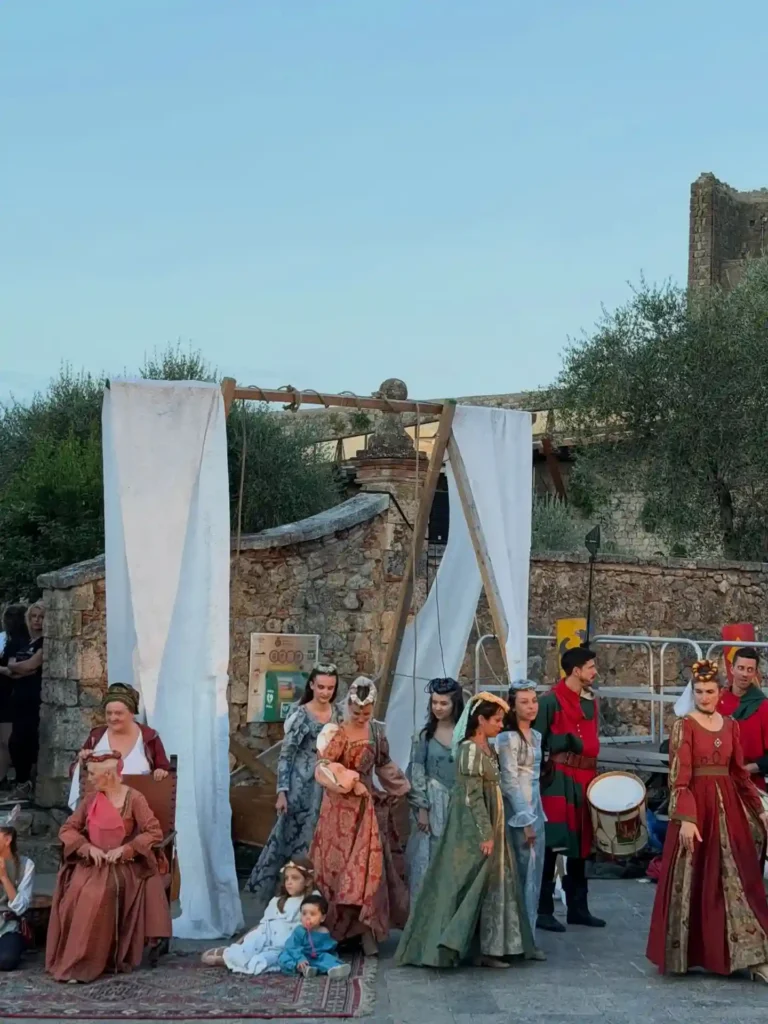
It was Dante himself who wrote about this place: “Monteriggioni di torri si corona” — “Monteriggioni crowns itself with towers.” He likely knew these walls well. Dante fought as a young soldier in the Battle of Campaldino, one of the many violent conflicts that shaped medieval Tuscany, and the fortified towns scattered across these hills were built because war was a constant reality. As we stood beneath Monteriggioni’s towers, it was impossible not to think about the generations of people who had fought, suffered, and died in these very fields.
The old castle we stayed in had been converted into an agritourism home nestled among thousands of olive trees. We were welcomed by Simone, a farmer whose family has cared for this land for generations. He and his wife, Laura, greeted us with homemade cake, family wine, and fresh-pressed olive oil from the surrounding groves. Simone’s quiet warmth and genuine friendship reminded us that some of life’s richest connections are found far from busy cities, where people still have the time to welcome strangers as friends.
That evening, by good fortune, the annual Monteriggioni Medieval Festival was taking place just a couple of miles away. We experienced one of Tuscany’s most authentic historical reenactments, where musicians, artisans, dancers, jousting knights, and townspeople fully embraced medieval life.
We also spent a day in Siena, one of the most beautiful and best-preserved medieval cities in Europe, with its magnificent red-brick architecture and breathtaking Piazza del Campo, one of the grandest public squares we encountered on our journey. From our fellow student, Tayor Thigpen, who had been here before, we learned about the Contrade, Siena’s 17 historic districts, whose identities are celebrated each year in the famous Palio horse race. The traditions, rivalries, and deep sense of belonging have endured for centuries, connecting each generation to those who came before.